
Correct quantification of oxygen vacancies in ferroelectric hafnia
Result of the Month
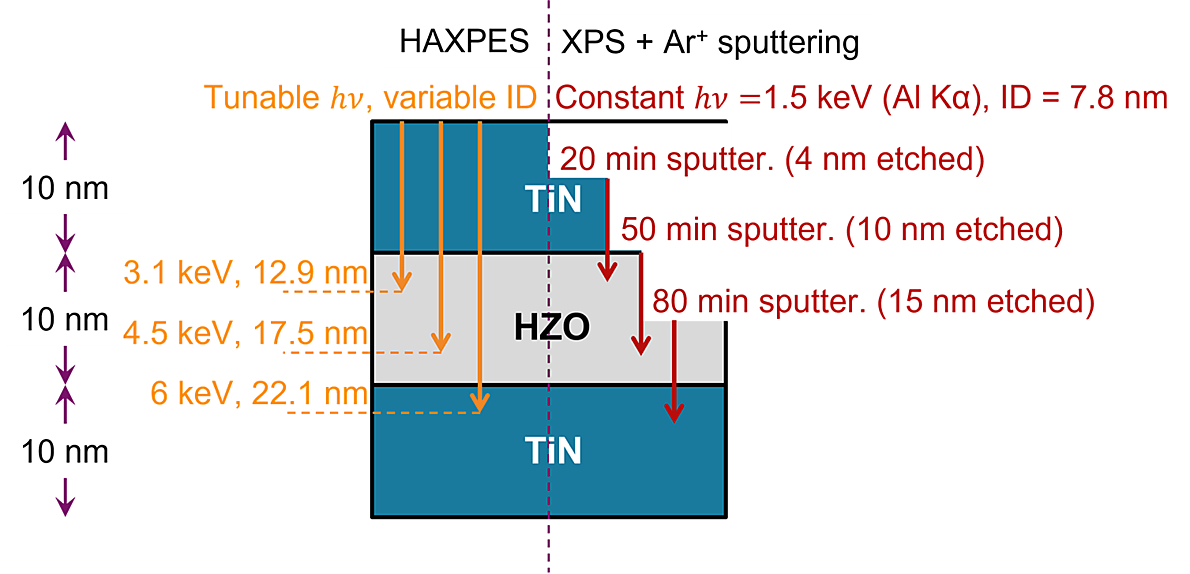
Illustration of the depth sensitivity of XPS (with sputtering) versus HAXPES (via photon energy tuning), showing comparable probing depths but vastly different impacts on sample integrity.
Ferroelectric hafnium oxide (HfO₂), especially in its doped form as hafnium zirconium oxide (HZO), is emerging as a key material for next-generation non-volatile memory and logic technologies. Its compatibility with CMOS processes and scalability to ultra-thin dimensions make it ideal for integration into advanced semiconductor architectures. The switchable polarization enabled by its metastable orthorhombic phase underpins its ferroelectric behavior, which is essential for data storage and logic operations.
However, the performance and reliability of HZO-based devices are highly sensitive to the concentration and distribution of oxygen vacancies (VO), which influence phase stability, leakage currents, and endurance. Modest concentrations of VO optimize the orthorhombic phase but higher concentrations favor the non-polar tetragonal phase and lower concentrations the non-polar monoclinic ground state. This study presents a rigorous comparison between conventional X-ray Photoelectron Spectroscopy (XPS) and Hard X-ray Photoemission Spectroscopy (HAXPES) for quantifying VO in ultra-thin ferroelectric capacitors. The authors demonstrate that Ar⁺ ion sputtering used in XPS depth profiling introduces significant artifacts, leading to overestimation of VO concentrations by up to an order of magnitude. In contrast, HAXPES provides accurate, non-destructive measurements, revealing realistic VO levels around 1%.
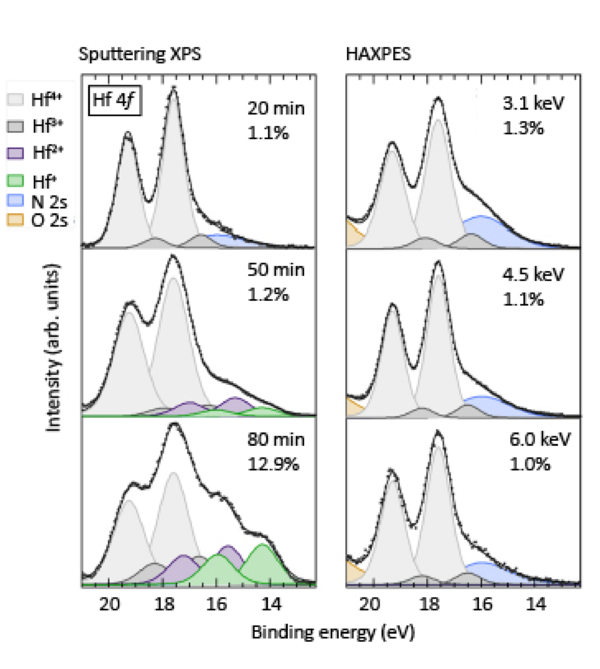
Side-by-side comparison of Hf 4f core-level spectra obtained via conventional XPS with time of Ar⁺ sputtering (left) and non-destructive HAXPES with variable photon energy (right) on TiN/HZO/TiN ferroelectric capacitors. The figure reveals how in XPS sputtering-induced artifacts, in particular preferential sputtering of oxygen, can dramatically inflate the apparent oxygen vacancy concentration— to up to 13% —compared to the realistic ~1% values measured by HAXPES. This result underscores the importance of using HAXPES for accurate defect profiling in ultra-thin ferroelectric films.
Key findings
- HAXPES reveals a gradient in VO concentration, highest near the top TiN/HZO interface, consistent with known oxygen scavenging effects.
- XPS results diverge significantly at deeper depths, falsely suggesting higher VO near the bottom electrode due to preferential oxygen sputtering.
Why it matters
This work provides a critical reassessment of XPS-based VO quantification in ferroelectric hafnia and establishes HAXPES as the preferred method for accurate, depth-resolved analysis. The findings are essential for:
- Materials engineering of hafnia-based ferroelectric devices.
- Reliable defect characterization in non-volatile memory and logic applications.
- Avoiding misinterpretation of core-level spectra, especially Hf 4f and O 1s, which has led to widespread errors in the literature.
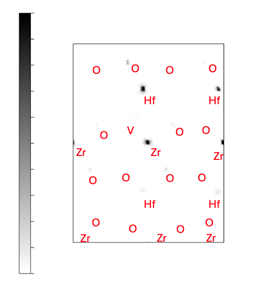
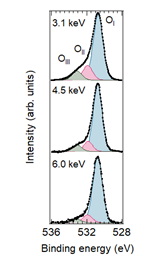
Charge density difference (in arbitrary units) induced by the presence of a single VO in a 96 atom unit cell, only cations adjacent to the VO site show significant change in charge density. As a result, calculating energy levels of closed-shell O 1s level using the variational self-consistent field method shows that there is no distinctive binding energy signature of VO in the O 1s spectrum and that the high binding energy components frequently ascribed in the literature as being du to VO are in fact simply surface contamination, as demonstrated by our HAXPES analysis shown on the right as a function of photon energy.