
Spectroscopic evidence of intra-unit-cell charge redistribution in a charge-neutral magnetic topological insulator
Result of the Month
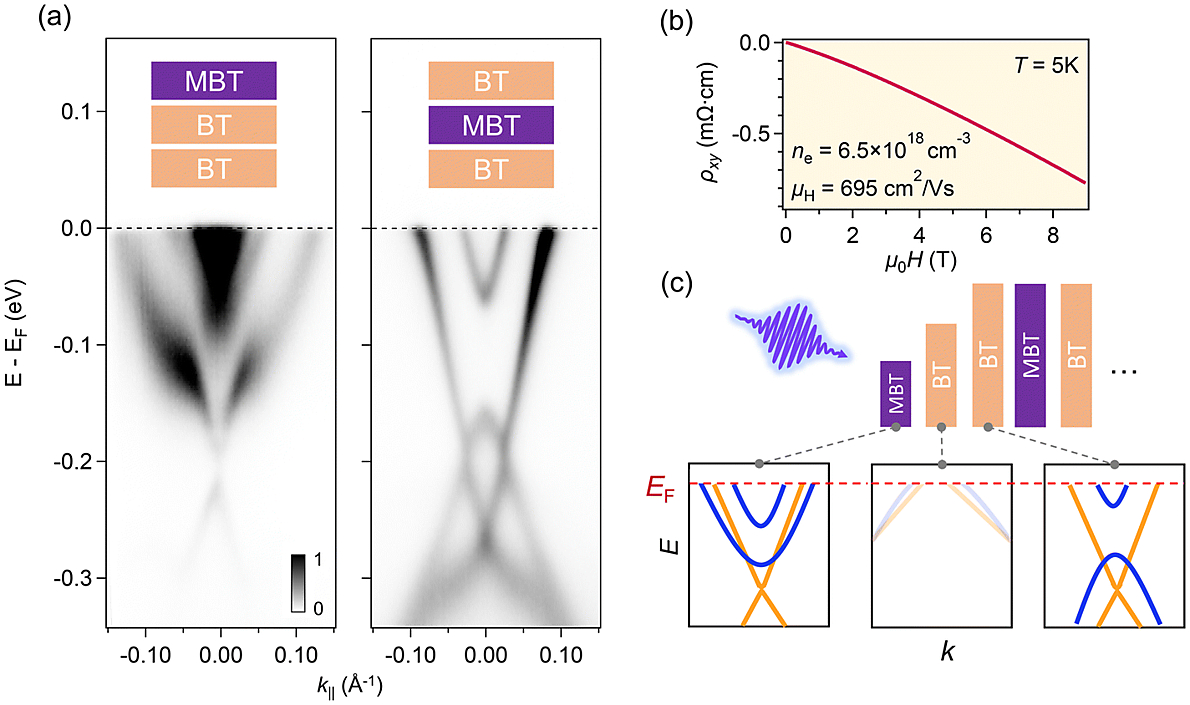
Equilibrium band structure of Mn(Bi1−xSbx)6Te10 with x = 0.18. (a) Band structures along the Γ–M direction on the MBT and 1-BT terminations. (b) Hall measurements for 18% Sb-doped MnBi6Te10 at 5 K showing the carrier density ∼6.5 × 1018 cm−3, near the charge-neutral point. (c) Illustrations of different cleaved terminations in MnBi6Te10 and sketches of their band structures.
Micro-ARPES measurements show sharp band structures of MnBi2Te4 and 1-Bi2Te3 terminations. These results generally agree with the previous measurements on undoped ferromagnetic MnBi6Te10.
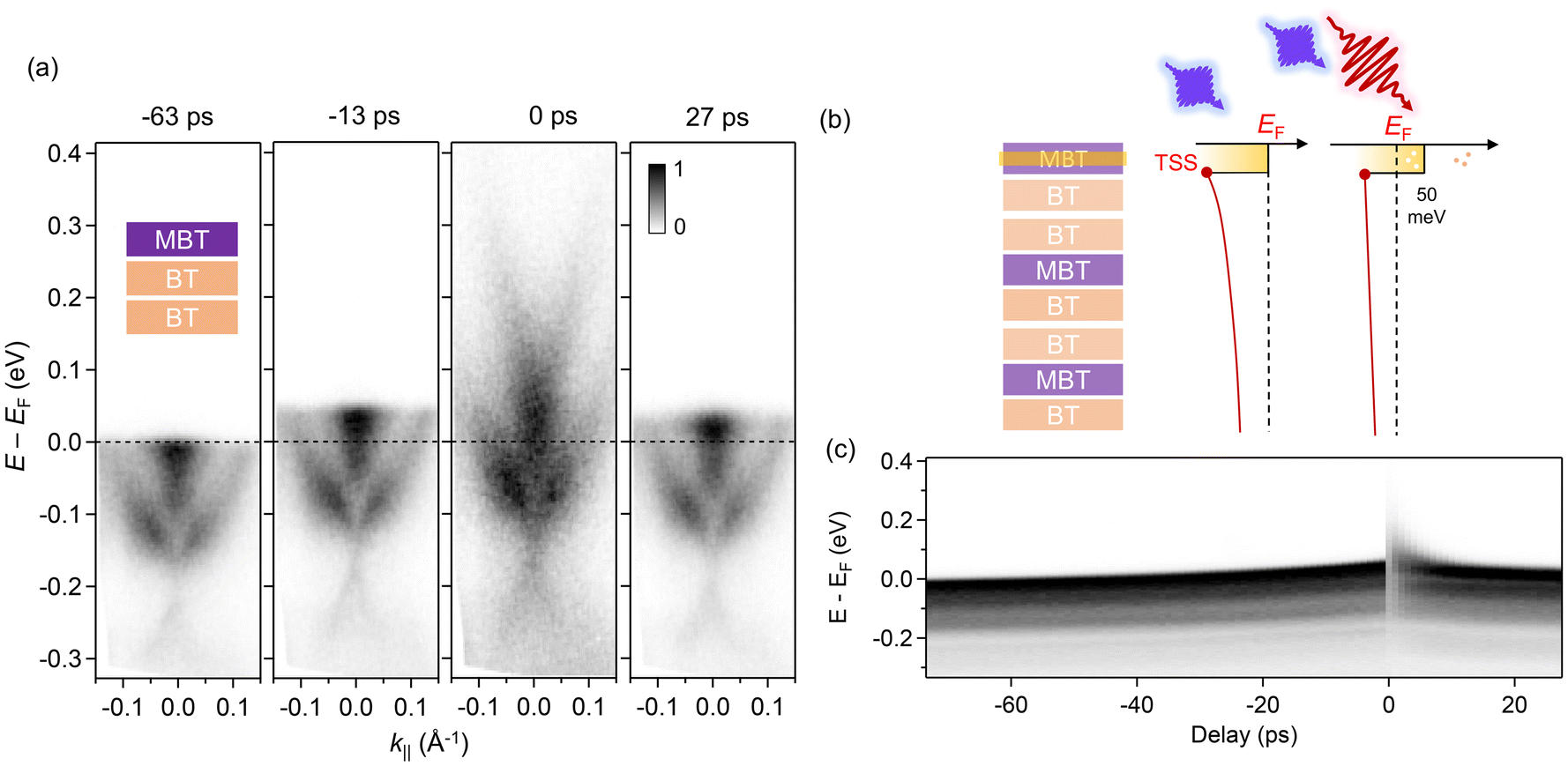
Surface photovoltage effect on the MBT termination. (a) trARPES spectra on the MBT termination at representative delays. The incident IR pump fluence is 95 μJ cm−2, at the over-saturated limit. (b) Proposed charge redistribution in Mn(Bi0.82Sb0.18)6Te10 and band bending toward the surface. When the sample is excited by the IR pump, electron–hole pairs are formed, flattening the bands and causing the uplifting of the whole band structure. The red solid line represents the overall band bending. The black dashed line stands for the equilibrium Fermi level. (c) Time-dependent energy distribution curves (EDC) around the Γ point. The zero energy corresponds to the Fermi level at equilibrium.
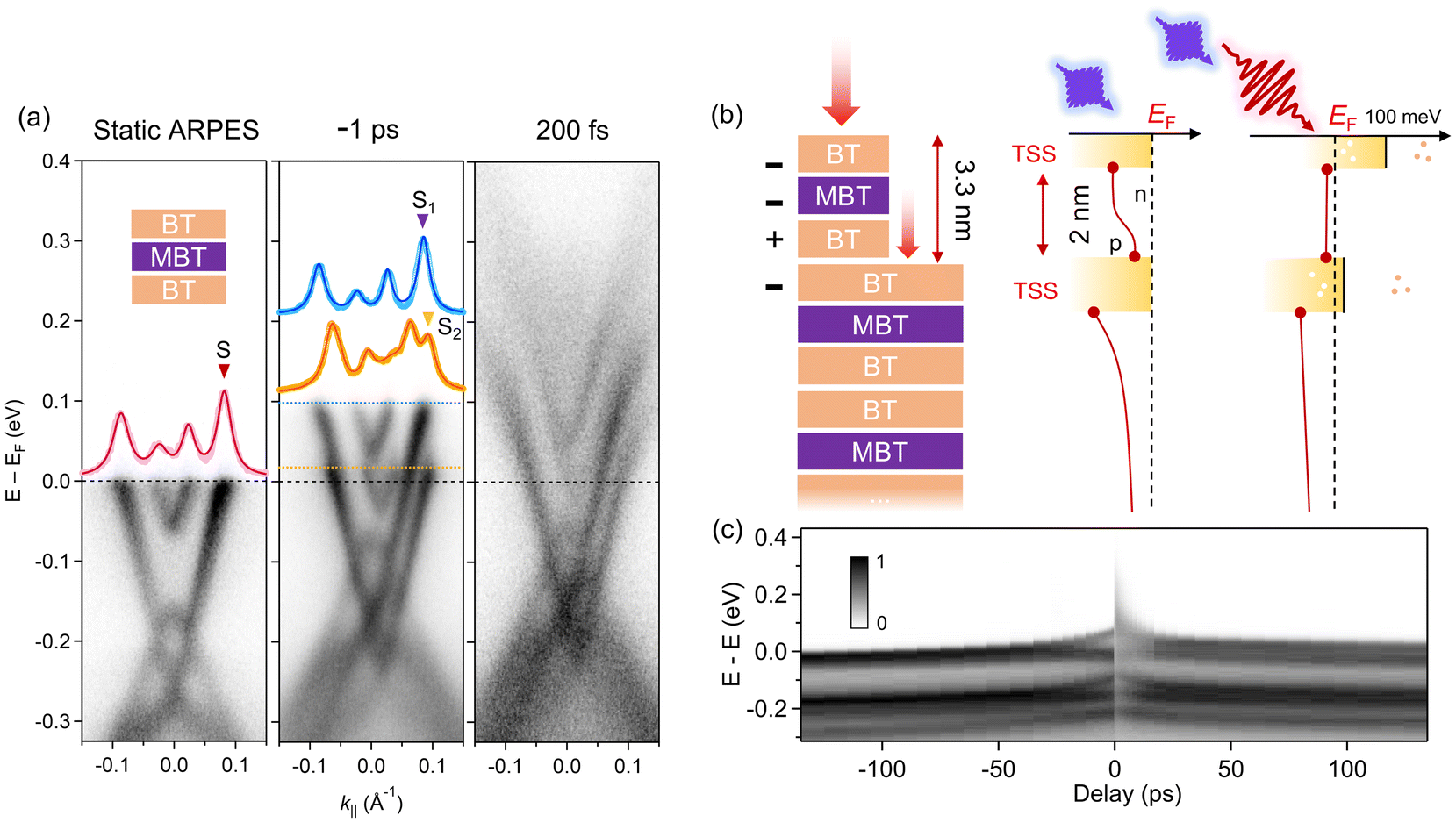
Multiple surface photovoltages on the 1-BT termination. (a) Static ARPES spectrum and trARPES spectra on the 1-BT termination with momentum distribution curves (MDCs) taken at the equilibrium Fermi level (static ARPES) and the shifted Fermi levels of two replica bands at −1 ps. Peak S at equilibrium is split into peaks S1 and S2 at −1 ps. The time-dependent spectra were obtained using an IR pump fluence of 95 μJ cm−2. (b) Proposed charge redistribution in Mn(Bi0.82Sb0.18)6Te10 and band bending toward the surface. The cartoons illustrate the dual-SPV effect at 2 adjacent exposed 1-BT terminations. The red solid line represents the overall band bending. The black dashed line stands for the equilibrium Fermi level. (c) Time-dependent EDCs around the Γ point clearly show the band splitting starting from around −30 ps and lasting more than 100 ps after time zero.
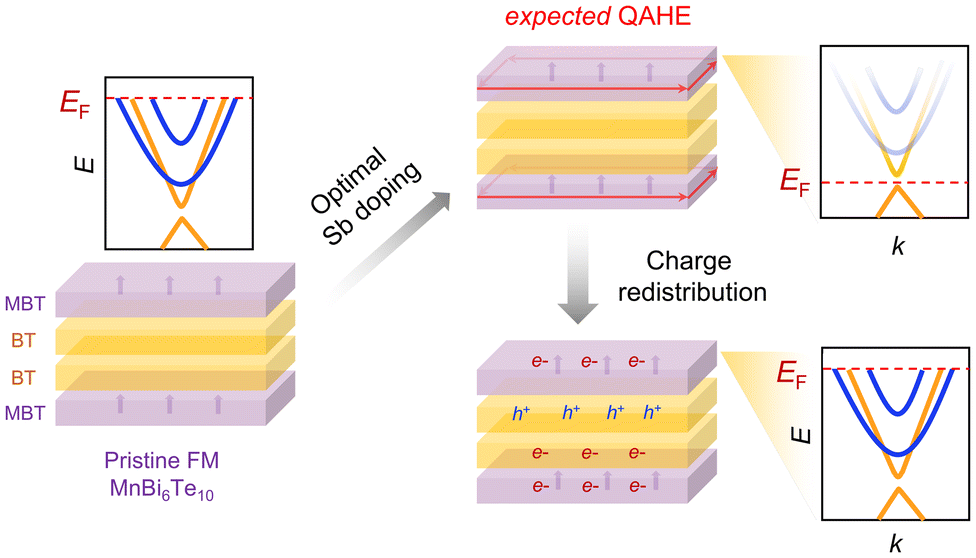
Charge redistribution in the charge neutral Mn(Bi0.82Sb0.18)6Te10 prevents the material from realizing the quantum anomalous Hall effect. Instead of the homogenous charge neutrality, the imbalance of the charge distribution always leaves the MBT layer electron-doped.
The static- and tr-ARPES measurements were performed on the multi-resolution photoemission spectroscopy platform at the University of Chicago, at a base temperature of 8 K. The 6-eV laser for static ARPES was generated from a mode-locked Ti:sapphire oscillator with a repetition rate of 80 MHz. The trARPES setup featured a 200-kHz Yb:KGW laser accompanied by noncollinear optical parametric amplifiers (NOPAs). For the pump path, a two-stage NOPA was tuned to generate the signal beam at 800 nm. For the probe path, the 206 nm probe beam was obtained by frequency quadrupling the signal output of a one-stage NOPA. The energy resolutions of the static and trARPES setups were better than 4 and 20 meV, respectively. Focused probe beam waists, as characterized by the full width at half maximum, were 14 × 17 μm2 and 24 × 25 μm2 for the static and trARPES experiments, respectively. A systematic alignment procedure was adopted to ensure the overlap of the probed regions for static and trARPES. Pump pulses were linearly polarized and 20-fs-long, with a beam waist of ~72 × 93 μm2 and a tunable incident fluence. The time resolution was determined to be ~150 fs, limited by the duration of the probe pulses. The Sb-doped MnBi6Te10 single crystals were cleaved in situ under a pressure < 5 × 10-11 mbar for the ARPES measurements.