
Interrogation of the Interfacial Energetics at a Tantalum Nitride/Electrolyte Heterojunction during Photoelectrochemical Water Splitting by Operando Ambient Pressure X‑ray Photoelectron Spectroscopy
Result of the Month
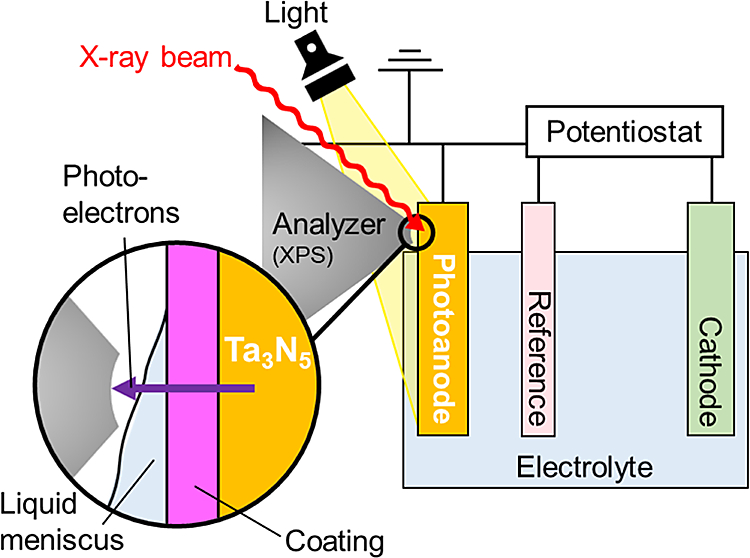
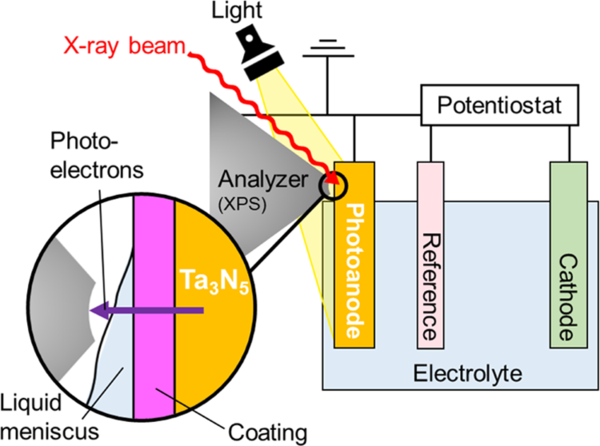
Schematic representation of the “dip and pull” setup in the ambient pressure condition analysis chamber. A liquid meniscus forms when the sample is dipped and pulled out slowly from the electrolyte solution. The solution is in equilibrium with its vapor pressure in the chamber. The working electrode (WE) is grounded to the analyzer (cone) to equalize the Fermi energy level of the detector with the contact of the WE. The reference (RE) and counter electrodes (CE) are used to control the potentials in the experiments with the use of a potentiostat. Simulated solar light was supplied externally through a view port.
What is unique with this measurement is the integration of photoelectrocatalytic and XPS experiments in a single chamber. In separate experiments, photoelectrocatalytic measurements are occurring at ambient pressure, while XPS under high vacuum conditions, but AP-XPS bridges this gap by an ingenious engineering of the XPS chamber. This allows to do real time spectro-photo-electrochemistry and follow shifts in the binding energies of the elements of interest under the application or not of an electric field, as well as light. As such, one can follow changes in biding energies in relation to light and externally applied electric fields. From this, a lot of important mechanistic data can be extracted while the photo-electrocatalytic experiments are happening.
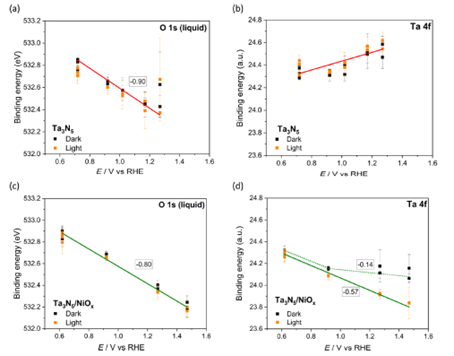
Binding energy of the Ta 4f7/2 component and liquid contribution in the O 1s spectra during operando AP-XPS measurements for a) and b) Ta3N5, and c) and d) Ta3N5/NiOx. Black and yellow markers represent measurements under dark and illuminated conditions, respectively. The current-voltage curves during operando AP-XPS can be seen in Figure S5. The PEC measurements in the AP-XPS chamber were conducted in 1 M KOH, Ag/AgCl (3.4 M KCl, liquid-less) as the reference electrode and a Pt sheet (2 cm2) as the counter electrode. Raw AP-XPS data can be found in Figure S6 and Figure S7.
Here we see exactly spectro-photo-electrochemistry, where we track the binding energy of Ta 4f and O 1s states under dark and light conditions, as well as under the application of potential. In some cases, we observe that the binding energy shifts are almost proportional to the applied electric field and/or light/dark conditions, while in others not. This is pretty remarkable as we can follow in real time the underlying mechanisms of a photo-electrochemical process, in this case, the photo-corrosion and eventually the failure of Ta3N5 as a photoelectrode in water electrolysis. Photocorrosion of semiconducting materials like Ta3N5 is a major bottleneck in photoelectrochemical water electrolysis keeping this technology from wider adoption.
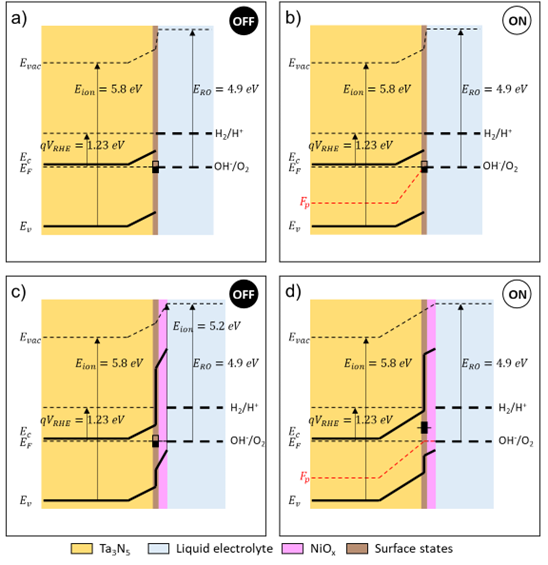
Band energy diagrams of a, b) Ta3N5/electrolyte under dark and illumination conditions, respectively and c, d) Ta3N5/NiOx/electrolyte in the dark and under illumination, respectively. Values below the Fermi level energy are obtained through XPS, while the work functions by UPS and are reported in eV
Ultimately, we are now able to directly probe the states of the elements of interest and draw solid mechanistic conclusions on important processes like (photo)corrosion. Herein, we resolved the role of NiOx, which is to passivate surface defects that act as corrosion initiating points, and we did this by following the shift in the Fermi level of the material. We were able to follow in real time the chemical states of Ta 4f and how these are changing under the application of light and externally applied electric field. Now, we have made a step forward on how to increase the stability of such materials under relevant operating conditions.