Manipulation of the anomalous Hall effect in magnetic topological insulator heterostructure MnBi2Te4/Bi2Te3 by Si substrate surface engineering
Result of the Month
Author: K. Ishihara, S. Ichinokura, S. V. Eremeev, T. T. Sasaki, R. Takada, H. Nishimichi, R. Akiyama, E. V. Chulkov,, T. Hirahara1
Institute:
''Hirahara Lab, Institute of Science, Tokyo ''
Applied Physics Letters
URL: https://doi.org/10.1063/5.0266580
Date: 5/2026
Instruments:
DA20
We developed an in situ Hall measurement setup and measured the anomalous Hall effect (AHE) in magnetic topological insulator heterostructures MnBi2Te4/Bi2Te3 grown on different Si(111) substrate surfaces. For the sample grown on the Si(111)- 7 x 7 surface, the AHE signal appears at 15 K and becomes larger by further cooling, showing that the Curie temperature Tc is 15 K. In contrast, although the Tc is the same, the AHE signal shows a local maximum at 10 K for the sample grown on the β-Bi/Si(111)- √3 x √3 surface. A plausible explanation for this peculiar behavior is the enhanced skew scattering caused by the Bi layer, or the presence of the states localized at the interfacial Bi layer, which will affect the Berry curvature of the system. Our results demonstrate the possibility to artificially control the property of a two-dimensional magnet by modification of the substrate surface with a single monatomic layer.
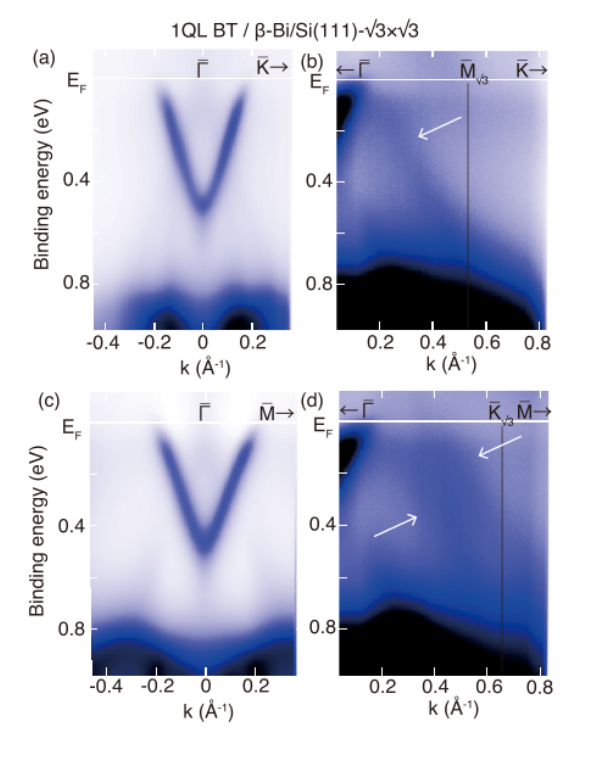
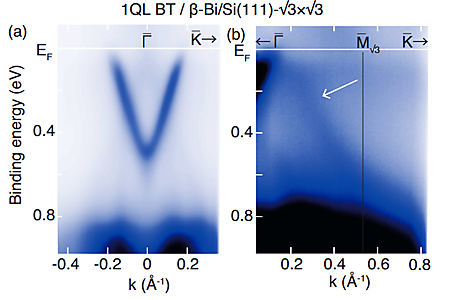
Figure 1: (a, b) Band dispersion of the 1 QL Bi2Te3 / β-Bi/Si(111)- √3 x √3 sample along the Γ-K direction. (c, d) Band dispersion of the 1 QL Bi2Te3 / β-Bi/Si(111)-√3 x √3 sample along the Γ-M direction.
The spectra are measured using DA20 hemispherical electron analyser and He-I UV source.
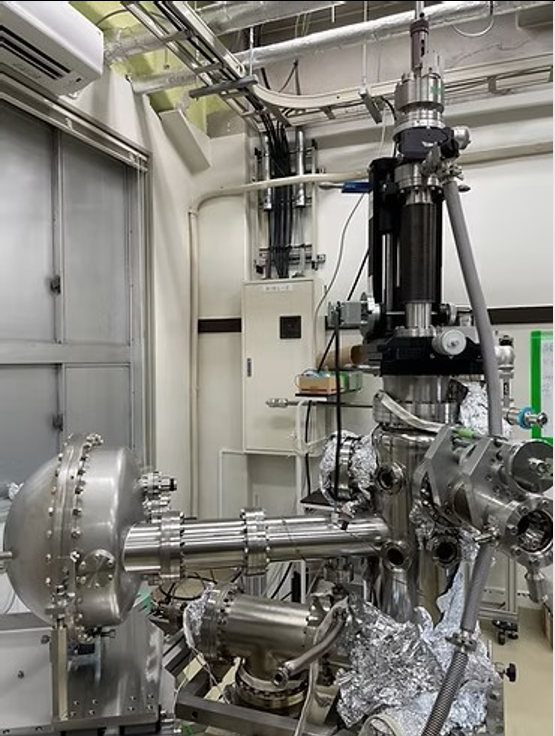
Figure 2: Home-built ARPES system (DA20 analyser) connected to a preparation chamber.
Quote from the Author: "Sharp spectra are observed using DA20 despite the large spot of the UV source (~1mm). It is compact and fits well in the labs. Laboratory-based ARPES, combined with sample growth (MBE) and other characterization techniques (STM, transport etc), provides playground to explore new materials."