
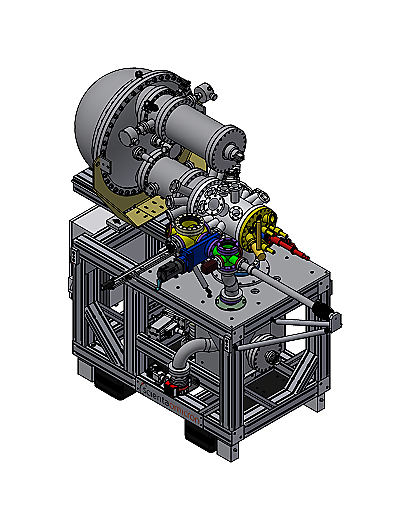
Impetus MIM
Momentum microscope with hemispherical energy analyser and multi-mode front lens
In a joint effort with Momentum Microscopy pioneer Professor Gerd Schönhense (University of Mainz), Scienta Omicron offers an advanced Momentum Microscopy solution that unites Prof. Schönhense’s latest developments with Scienta Omicron’s expertise in high-resolution ARPES (angle-resolved photoelectron spectroscopy) and an extensive track record of building complex UHV systems.
The new Impetus analyser combines a momentum and imaging microscope (MIM) with a single hemispherical energy analyser (HEA) with microchannel plate/camera detector and the recently introduced multi-mode front lens.
Impetus MIM Lab
Momentum microscope with hemispherical energy analyser and multi-mode front lens
- Lens column consisting of
- Special objective lens
- Two sets of zoom optics to create intermediate real space and k-space images, each zoom optic with octopole stigmator and deflector
- Arrays of 7 contrast and 16 field apertures with UHV compatible, non-magnetic piezo motors with encoders
- Double mu-metal shield enclosing the lens elements
- Extension for sub-µm ARPES, XPEEM, and dark-field imaging (German patent DE10 2020 104 151 B3), including enlarged aperture arrays for field and contrast apertures
- Multi-mode front lens for reduction of the extraction field at the sample or suppression of space charge effects due to slow electrons (German patent DE10 2017 126 882 B3)
- Hemispherical energy analyser (HEA) with 200 mm mean radius
- HEA pass energy range 2-200 eV with pre-defined settings in the range 2-25 eV and further settings for higher pass energies
- Detector unit using a microchannel plate plus phosphor screen and camera
- Simple switching between “image” and “event” detection mode measuring integrated intensity or counting single events at low intensity, respectively
- Data acquisition PC with pre-installed software based on Scienta Omicron’s PEAK
- Energy resolution < 10 meV
- Spatial resolution in PEEM mode < 50 nm
- Minimum region-of-interest in k-mode < 1 µm diameter
- k-space resolution < 0.01 Å-1
High-precision hexapod sample stage with LHe cooling
- ±10 mm x/y travel (lateral) and 25 mm z travel (sample retraction for letting the exciting photon beam pass through), as well as 2 orthogonal tilt motions (±5°) for fine tuning of the sample orientation
- Optional goniometer for 0-200° azimuthal sample rotation
- Ex vacuo motors with encoders
- Electrically insulated sample acceptor stage made from Au-coated OFHC copper. Suitable for standard Scienta Omicron sample flags, no special sample plates needed!
- LHe flow cryostat, temperature range: < 15…500 K
Excitation Sources
- UV-LED for pre-alignment without the need for water cooling
- Small spot gas discharge lamp for continuous excitation with VUV light
- 3-stage differential pumping system to maintain minimal background pressure in the microscopy chamber
- Multilayer focusing mirrors
- Port on microscopy chamber for connection to a Synchrotron or laser system
UHV System
- Mu-metal analysis chamber (two layers) with ports for excitation sources, a sample stage, one connection port to a laser or Synchrotron, and several spare ports, e.g. for in vacuum lenses and mirrors or further excitation sources
- Set of UHV pumps (ion getter, TSP, turbo pump, oil-free backing pump) and pressure gauges for the main chamber and the analyser body
- Guaranteed base pressure < 5 x 10⁻¹⁰ mbar
- Scienta Omicron’s MISTRAL control system including comprehensive interlocks for intuitive, user-friendly and fault-proof operation of the UHV system
- Rigid bench for operation of a high-resolution microscope; optional Synchrotron adjustment frame
- Sample storage chamber (10 positions) and separate loadlock for multiple flag-style sample plates, allowing convenient sample handling
- Extension possible, e.g. with Scienta Omicron’s Multiprobe Prep for sample preparation and SPM, or a UHV suitcase for sample exchange with remote UHV systems
More Information
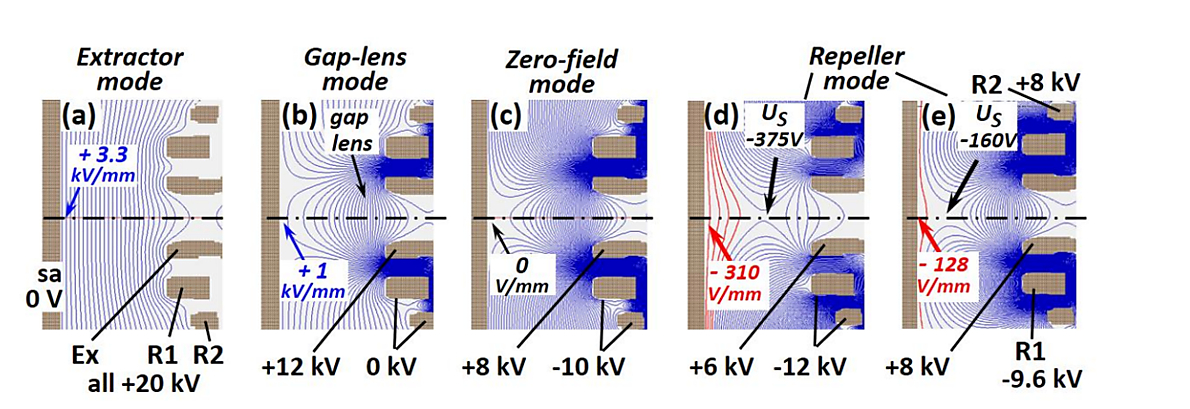
Fig. 1. Operating schemes for the various modes of the new front lens, with the contours of equipotential surfaces. (a) Classic extractor mode with the extractor Ex and ring electrodes R1 and R2 at 20 kV, resulting in a homogeneous field of F=+3.3 kV/mm. (b) Gap-lens mode (thin black line), UEx=12 kV and UR1=UR2=0, resulting in the formation of an additional lens in front of Ex, which reduces the field to F=+1 kV/mm at the sample. (c) Zero-field mode (F=0), achieved with UEx=8 kV and negative ring electrodes (UR1=UR2=-10 kV). (d) Repeller mode, here with F=-310 V/mm, attained with UEx=6 kV and UR1=UR2=-12 kV. The saddle point at US=-375 V defines the low-energy cut-off. (e) Repeller mode, modified by setting UEx=UR2=+8 kV and UR1=-9.6 kV. In (d,e) the retarding field is indicated by red potential contours.Illustration of various multi-mode lens settings (image and caption from https://arxiv.org/pdf/2408.10104)
Further details can be found in the following publications:
(1) O. Tkach, G. Schönhense: “Multimode objective lens for momentum microscopy and XPEEM: Theory”, Ultramicroscopy 276 (2025) 114167
(2) O. Tkach, S. Fragkos, D. Biswas, J. Liu, O. Fedchenko, Y. Lytvynenko, S. Babenkov, D. Zimmer, Q. L. Nguyen, S. Chernov, D. Kutnyakhov, M. Scholz, N. Wind, A. Gloskovskii, F. Pressacco, J. Dilling, L. Bruckmeier, M. Heber, L. Wenthaus, G. Brenner, D. Puntel, P. E. Majchrzak, D. Liu, F. Scholz, J. A. Sobota, J. D. Koralek, G. Dakovski, A. Mehta, N. Sirica, M. Hoesch, C. Schlueter, L. V. Odnodvorets, Y. Mairesse, T.-L. Lee, A. Kunin, K. Rossnagel, Z. X. Shen, H.-J. Elmers, S. Beaulieu, G. Schönhense: “Multimode objective lens for momentum microscopy and X-ray photoemission electron microscopy: Experiments”, Rev. Sci. Instrum. 97, 033703 (2026)