BL46XU: an applied hard X-ray photoelectron spectroscopy beamline HAXPES II at SPring-8
Result of the Month
Author: Satoshi Yasuno, Yasumasa Takagi, Akira Yasui, Okkyun Seo, Taito Osaka, Michihiro Sugahara, Yasunori Senba, Hiroshi Yamazaki, Takahisa Koyama, Satsuki Shimizu, Takamitsu Saito, Haruhiko Ohashi, Naomi Kawamura, Kyo Nakajima, Koji Motomura, Tappei Nishihara, Masugu Sato, Yusuke Tamenoria and Makina Yabashia,b
Institute:
aJapan Synchrotron Radiation Research Institute, Japan,
Journal of Synchrotron Radiation
URL: https://doi.org/10.1107/S1600577525007660
Date: 11/2026
Instruments:
HiPP-2
Owing to the development of third-generation high-brilliance synchrotron radiation sources and relevant instruments, hard X-ray photoelectron spectroscopy (HAXPES) has recently become a powerful tool for investigating the chemical states and electronic structures of various materials. The most advantageous feature of HAXPES is its capability to probe bulk and buried interfaces lying at depths of several tens of nanometres due to its large probing depth, which are inaccessible in conventional photoelectron spectroscopy with vacuum ultraviolet or soft X-ray beams (Tanuma et al., 2003 ; Kobayashi, 2009 ). Therefore, HAXPES has been utilized for versatile analysis in various research fields, such as electronic devices, inorganic and organic materials, and rechargeable batteries (Kobayashi et al., 2003 ; Yabuuchi et al., 2011 ; Watanabe et al., 2016 ). At present, HAXPES has been installed in various beamlines of synchrotron radiation facilities worldwide (Kalha et al., 2021 ). At SPring-8, HAXPES had been operated on several beamlines including public beamlines BL09XU, BL47XU (Ikenaga et al., 2013 ; Ikenaga et al., 2018 ) and BL46XU (Yasuno et al., 2016 ), while the operation and technical development has been carried out independently. Recently, we have consolidated major HAXPES activities at SPring-8 into BL09XU and BL46XU with major revisions of beamline configurations and instruments. BL09XU (HAXPES I) is mainly organized for advanced HAXPES measurements, such as resonant analysis and three-dimensional microanalysis (Yasui et al., 2023 ), while BL46XU (HAXPES II) has been upgraded for high-throughput analysis and measurements in ambient-pressure environments.
In this article, we present the latest design of the upgraded beamline BL46XU and report test results that verify its capabilities.
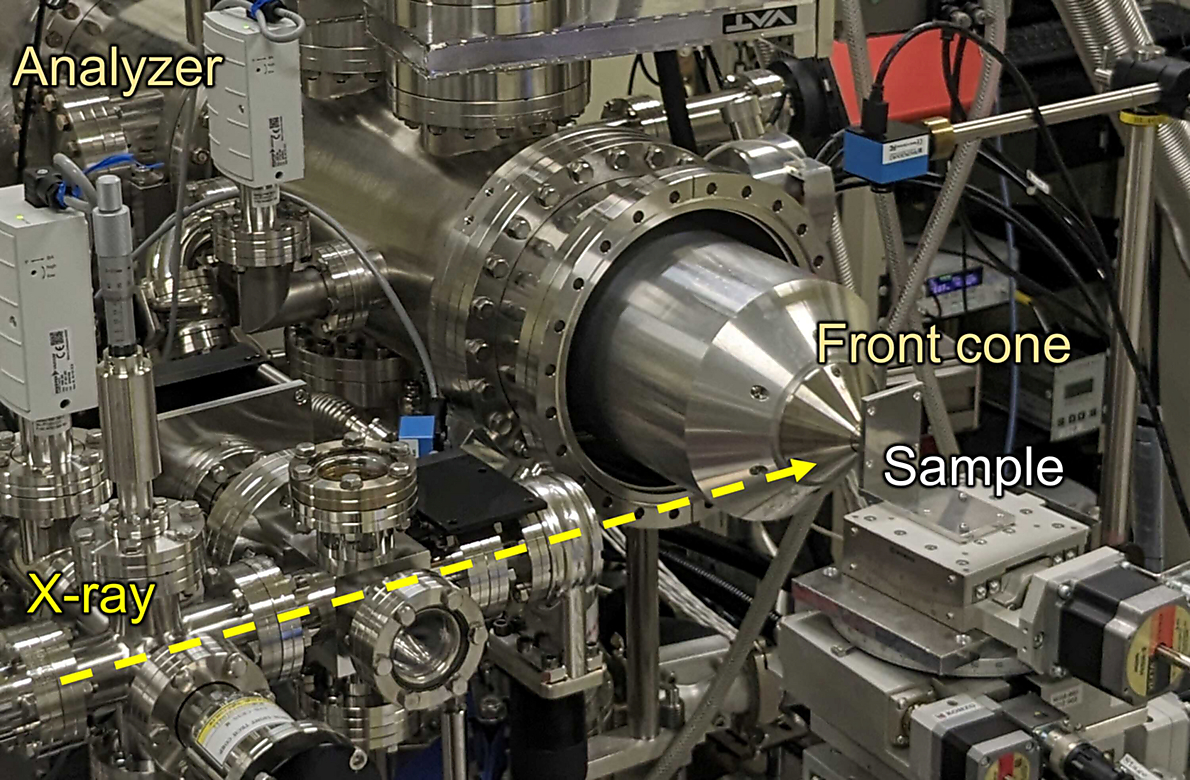
Photograph of HAXPES measurements under conditions where the measurement chamber has been removed.
Measuring at true ambient, atmospheric conditions(i.e. without a chamber) is demonstrated by the excellently matched properties of the HiPP-2 analyser and the reorganized BL46XU beamline of SPring-8. This property of applied materials under atmospheric condition is a land mark in applied research development where a future of XPS measurements without a chamber become a feasible reality.
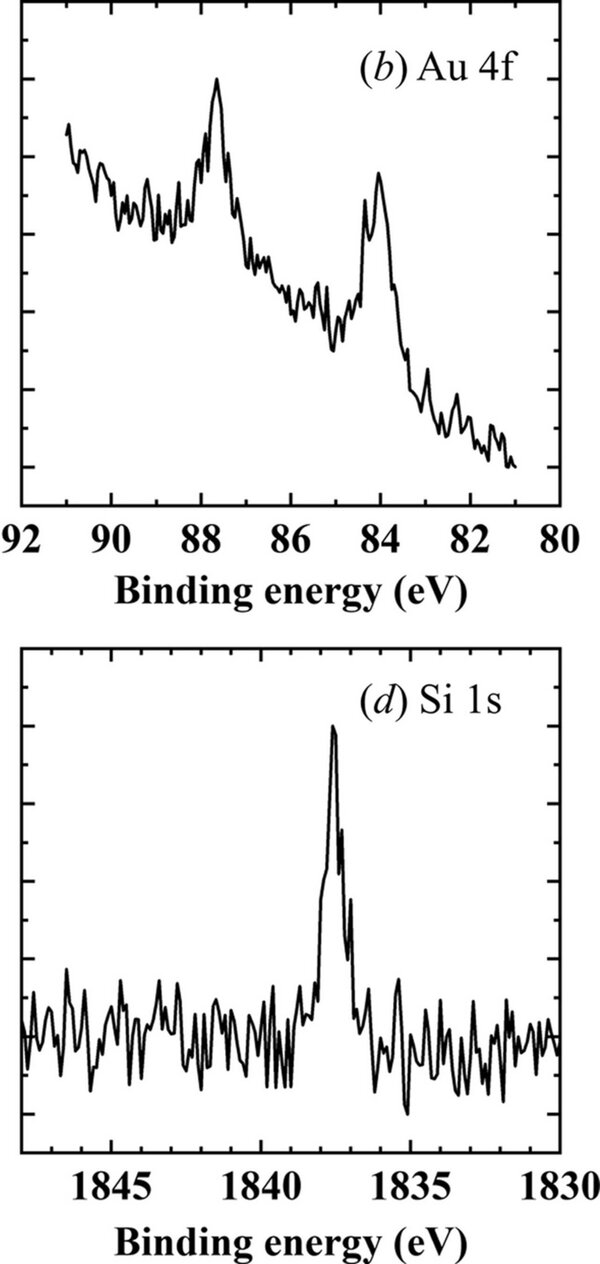
HAXPES measurements under atmospheric conditions. (b) Au 4f peak of Au thin film and (d) Si 1s peak of Si substrate. The dwell time per point is 1 s for Au and 0.2 s for Si, resulting in total measurement times of 10 min for Au and 2 min for Si.
For the Au thin film, the Au 4f peak was successfully resolved [Fig. 8[link](b)]. Peak fitting analysis revealed a spin–orbit splitting of 3.7 eV between the Au 4f7/2 and Au 4f5/2 components, consistent with values reported in the literature. In the case of the Si substrate as shown in (c) and (d), the bulk sensitivity of HAXPES enabled the detection of the pure silicon peak beneath the native oxide layer (Takata et al., 2005View full citation).